
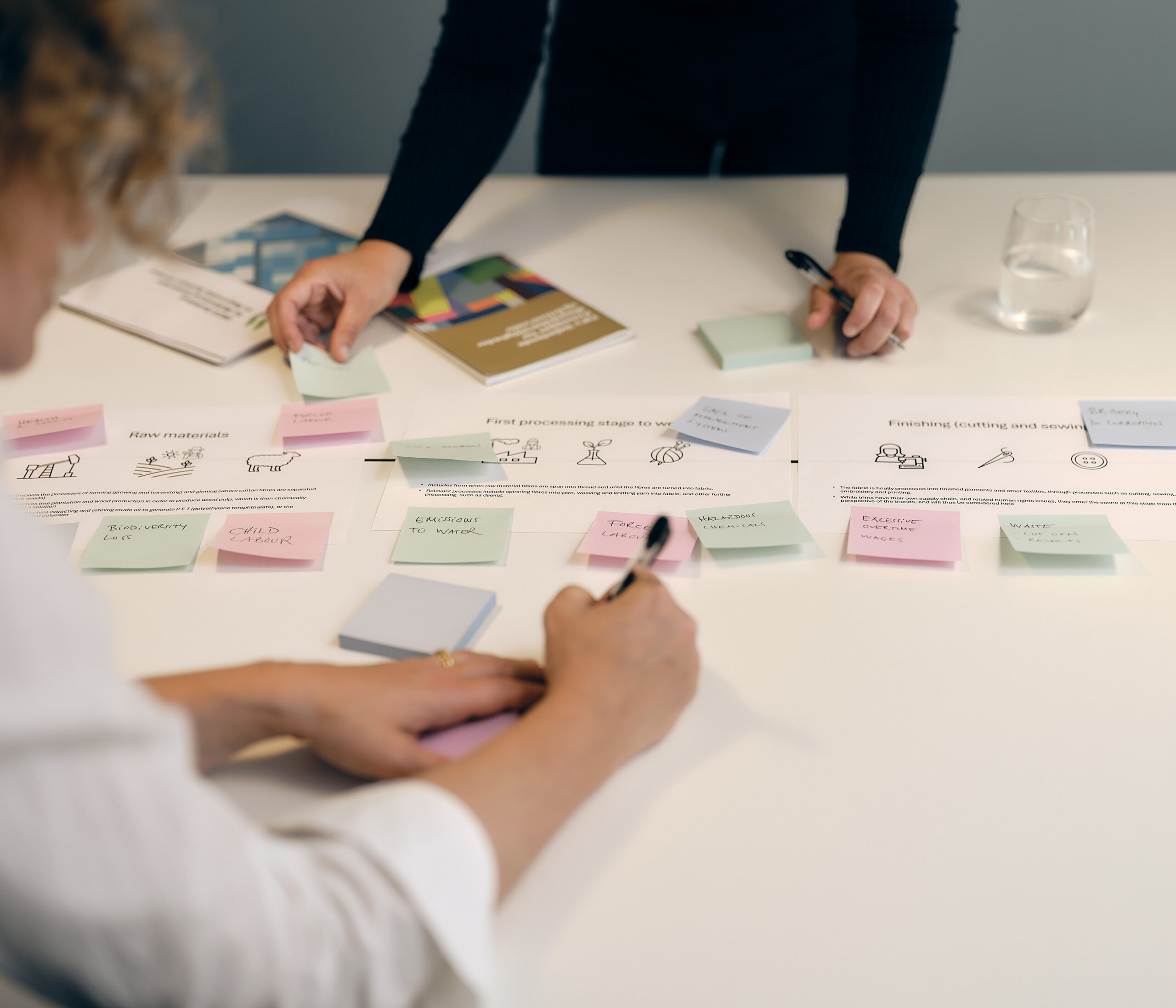
Our Units engaged in a tailored competency development course consisting of engaging workshops and ongoing sparring designed to strengthen their competencies in responsible business practices and due diligence. This course, which was funded through the SME:Green Competencies enterprise program, played a crucial role in shaping and improving Our Units’ strategies and actions in ESG and sustainability.
Every company is different and therefore the content of the course was adapted to Our Units. They have worked sincerely and purposefully with responsibility for many years, and therefore had a strong foundation and a very good internal understanding of their company, value chains and product footprint, and have many initiatives and measures within responsibility broadly.
Signe’s facilitation of the competency development course in due diligence has been crucial for our understanding of the process and motivation for the work at hand. Signe has contributed, among other things, with clear tools, so that we have made a good start with improvements in our work with due diligence – and have created a strong foundation to continue to make a positive impact in our value chain.
Kamilla Gitter, Head of Purchase // Heart of Impact at Our Units
The course consisted of 5 workshops, where each workshop has helped Our Units with key parts of the due diligence process.
Workshop 1: Introduction to due diligence in practice
The first workshop focused on the basic elements of the due diligence process. The emphasis was on a practical and easy-to-understand approach to why due diligence is essential and how it supports compliance with relevant legal requirements. This workshop set the framework for the remaining course and provided a thorough introduction to a structured approach to accountability.
Workshop 2: Due diligence gap analysis
In this session, we delved into an analysis of the current practices at Our Units compared to the due diligence requirements. Through an interactive gap analysis, conducted orally and documented in Excel, the participants were able to identify existing strengths in the organization, as well as areas for improvement, which both defined the focus of the remaining workshops and can serve as a future action plan.
Workshop 3: Value chain and risk assessment
The third workshop was centered around the value chain, where we worked with methods and tools to map and assess impacts on people and the environment. The first step was to map the value chain, after which we mapped specific risks in each value chain link, e.g. risks associated with the use of chemicals, CO2e emissions, risk of child labor, overtime, discrimination, etc. After this workshop, Our Units started their due diligence risk assessment (written in a flexible Excel sheet), which they subsequently worked on further and received my concrete input.
Workshop 4: Evaluation and development of new initiatives
This workshop was dedicated to evaluating and mapping the existing responsibility initiatives in their own company and in the value chain. The participants went through a thorough analysis to identify the initiatives already underway. Based on this review, we mapped out new necessary initiatives together, which gave the company a clear path forward to strengthen their sustainability efforts. Our Units used the same risk tool as in workshop 3, and in this way the risk assessment also became their future action plan.
Workshop 5: Internal anchoring and continuous evaluation
The final workshop focused on internal anchoring and a reassessment of the gap analysis from workshop 2. This workshop helped Our Units to make visible where they have moved through this process and where they need to focus over the next year. At the same time, work was done to implement a due diligence annual wheel – both for their own company and for suppliers. This tool is designed to ensure that all responsibility processes are clearly planned and assigned specific areas of responsibility and timeframes. These initiatives emphasized the importance of a clearly anchored and continuous process within Our Units’ work with due diligence and responsibility.
You are welcome to reach out if you are interested in a similar course.
October 2024